
Wedding Music at the Museum of Fine Arts, St. Petersburg and Sunken Gardens
Two beloved St. Petersburg settings, heard from the music stand.
Some places seem to listen before the first note is played.
We know the Museum of Fine Arts, St. Petersburg and Sunken Gardens from behind the music stands. Sunset Strings has performed a violin-and-cello duo for a courtyard ceremony at the museum, and both a duo and a string quartet at separate Sunken Gardens celebrations. This guide brings together those performances, the venues’ current event materials, and our experience shaping live music around real ceremony plans.
The short answer: The right ensemble begins with the exact ceremony setting. Seating depth, musician placement, repertoire, natural and mechanical background sound, weather protection, and any venue-approved reinforcement shape what guests hear. A duo can be beautifully complete; a trio adds an inner voice and harmonic warmth; a quartet offers the broadest four-part palette. Each offers its own complete musical character, and the ceremony plan guides the choice.
What actually shapes outdoor wedding acoustics?
Outdoors, open sky gives music room to travel, with fewer enclosing surfaces returning sound toward the listener. Musical detail therefore depends more strongly on distance and direction. Leaves and irregular planting may scatter portions of the sound; in most ceremony plans, the final guest row, the direction the instruments face, wind, ground surfaces, water, nearby activity, and a clear path from the bows to the seating usually carry greater practical weight.
That is why we plan from the first chair to the final guest row. We trace the processional path, the players' sightlines, the ceremony's pacing, and the moments when the music must feel near. Musicians often serve the ceremony best close to the front and just off its visual axis, angled so the sound has an unobstructed path across the seating while the aisle and coordinator remain in view.
Our aim is to give each important moment a musical presence that feels entirely at home.
Wedding music at the Museum of Fine Arts, St. Petersburg
At the Museum of Fine Arts, music enters into conversation with architecture, art, pattern, and proportion. The museum's current private-event settings include the Mary Alice McClendon Conservatory and Terrace, Marly Room, Membership Garden, and Sculpture Garden. Its materials describe a Spanish-style Membership Garden framed by rich foliage, columns, arched loggias, and vaulted passages; a Sculpture Garden where permanent works meet tropical planting and natural light; a two-story glass Conservatory overlooking the bay; and a Marly Room with a 22-foot ceiling, crystal chandeliers, and a wooden floor.
These surfaces, volumes, and sightlines shape a thoughtful music plan.
Our first-hand experience at the museum
For one MFA courtyard ceremony, our violin-and-cello duo occupied a compact footprint framed by tilework and patterned metalwork. The violin carried the luminous upper line; the cello brought warmth, depth, and a sense of arrival. Two players created a complete musical texture because the repertoire, seating depth, musician position, and ceremony cues were considered together.
The photograph below documents that courtyard performance. Our records identify the setting simply as a courtyard, and each museum wedding begins with its own contracted space and approved layout.
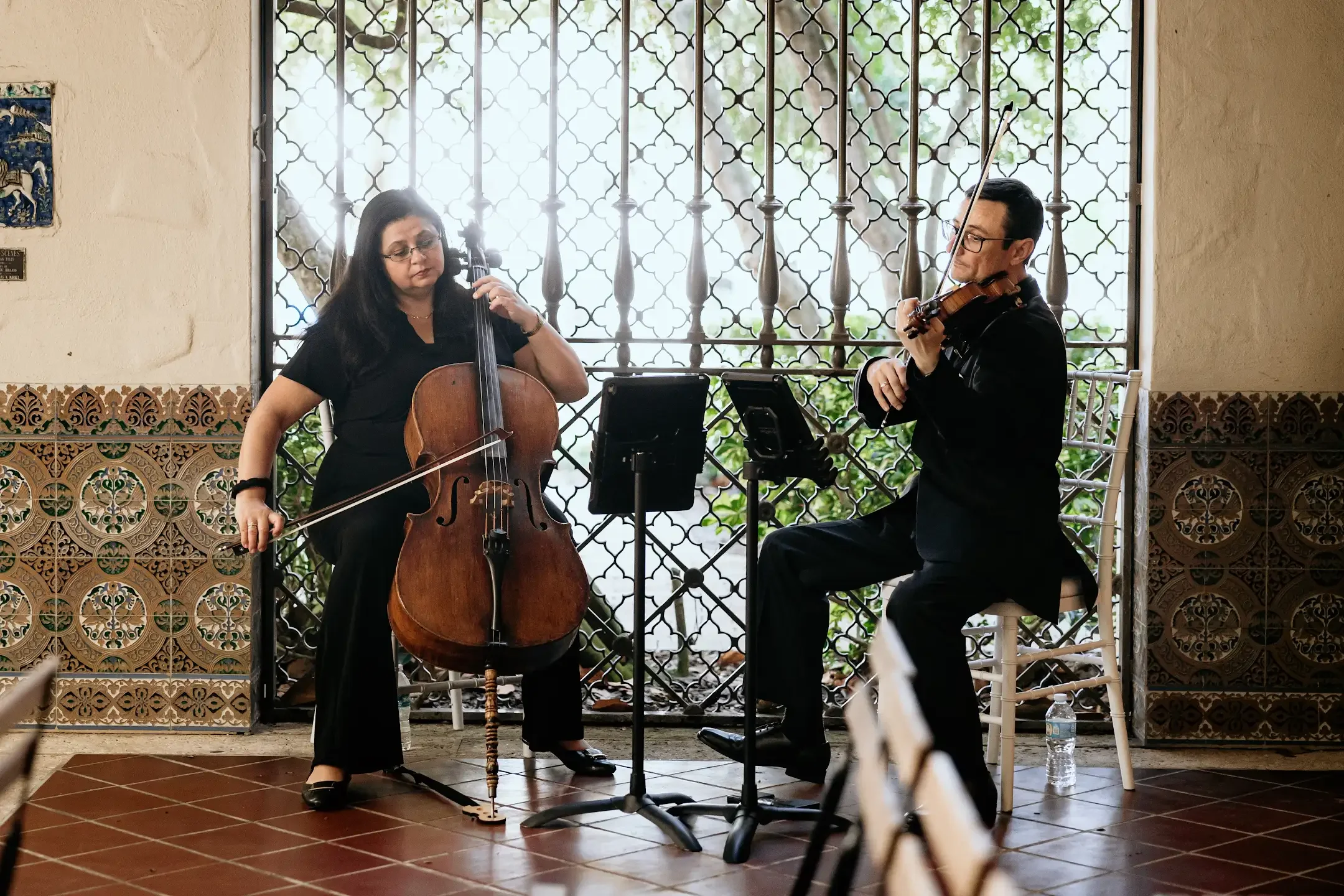
A Sunset Strings duo performs in an MFA courtyard. Photograph by Rabecca Cruz Photography.
How architecture can shape clarity and placement
Nearby hard surfaces such as tile, brick, stone, walls, arches, and glass can return more sound toward guests than open air alone. The result remains distinctly open-air, with its clarity and resonance shaped by geometry, guest bodies, furniture, open doors, weather, background systems, and the direction of the instruments.
In practice, we preserve a clear path from the bows to the seating and position the ensemble where architectural and floral elements frame it gracefully. When the layout permits, we listen from the final row once the chairs and ceremony design are in place. That last-row perspective often tells us more than a capacity number.
The museum’s other settings invite the same attentive listening. Glass and other hard surfaces in the Conservatory make reflection more likely than in open air, while guests, tables, linens, and placement shape its clarity and resonance. The Marly Room’s height, wooden floor, chandeliers, and continuing chamber-music tradition give strings a culturally natural home. We plan for each dressed room as it will exist for the event.
The repertoire can be as personal as the setting. Bach and Handel feel entirely at home, and so can an elegant contemporary ballad, a jazz standard, a film theme, or the song that has belonged to a couple for years. The music can share the art’s sense of intention while speaking in a voice all its own.
Wedding music at Sunken Gardens in St. Petersburg
More than a century old, Sunken Gardens describes itself as St. Pete's oldest living museum: a tropical oasis of more than 50,000 exotic plants, with birds, ponds, waterfalls, and winding paths held within its historic landscape. Weddings have taken place here since 1935. Its current named ceremony settings are the historic Wedding Lawn, North Lawn, and Oak Pavilion, while the Garden Room occupies part of the historic main building.
At Sunken Gardens, music becomes part of a living composition—layered greens, filtered light, water, garden paths, and the gentle movement of an outdoor setting.
Our first-hand experience in the gardens
We have performed both a violin-and-cello duo and a string quartet at separate Sunken Gardens celebrations. Those weddings taught us to listen for the garden’s own voice. Waterfalls, bird calls, breeze, guest arrival, and nearby activity may all become part of the soundscape. We position and shape the strings so the musical line remains beautifully present within the life already sounding around it.
A classical prelude can feel suspended in the landscape. Modern love songs take on an organic warmth when translated into strings. A cinematic processional can gather energy with each walk down the aisle, while a buoyant recessional seems to send its joy straight into the trees. From classical to contemporary, the garden gives the chosen repertoire a living frame.
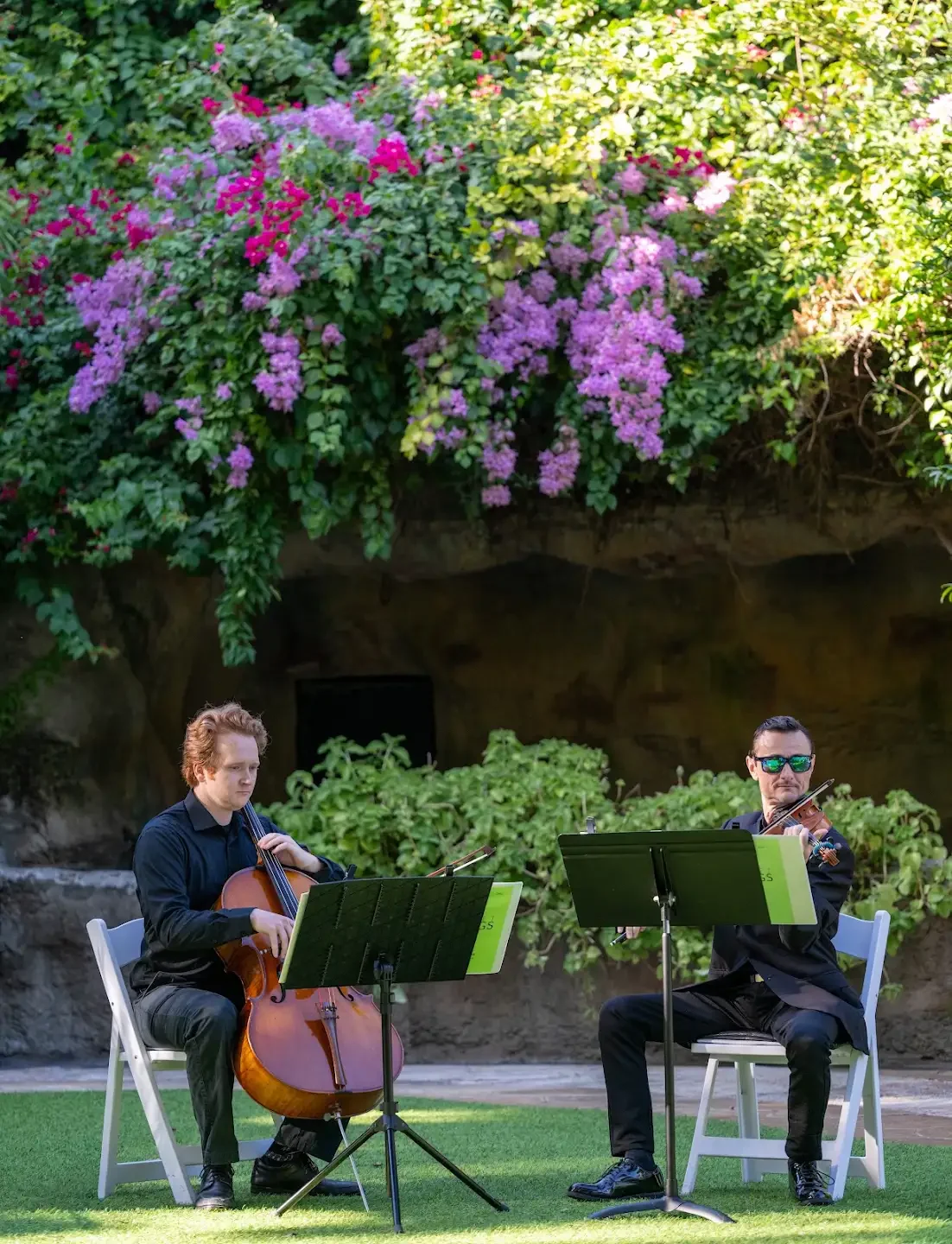
A Sunset Strings duo performs on a lawn at Sunken Gardens. Photograph by Jonathan Dyer Photography.
How open air and the garden soundscape shape the music
On the lawns, open-air distance governs the acoustics. The direct musical line feels most vivid nearest the ensemble and grows gentler as the seating extends across the lawn. Grass and soil generally return less sound than hard paving. Leaves and irregular planting may scatter portions of the sound; in most ceremony plans, the final guest row, the direction the instruments face, wind, ground surfaces, water, nearby activity, and a clear path from the bows to the seating usually carry greater practical weight.
For a North Lawn or Wedding Lawn ceremony, musicians often work beautifully near a front corner, slightly ahead of the first rows and angled across the seating. That position gives the instruments a clear path, preserves sightlines to the aisle and coordinator, and lets the ensemble feel gracefully present at the ceremony’s edge. We also listen at the actual event hour whenever possible, because water, birds, traffic, fans, and guest movement can change the perceived balance.
At the Oak Pavilion, the architecture is living. Its Southern live oak was estimated by arborists in 2019 to be approximately 150 years old, with a limb span of more than 150 feet. Beneath that extraordinary canopy, a duo or trio can sit lightly within the atmosphere, while a quartet can create a generous sweep when the plan allows space for four chairs, four stands, full bow movement, and easy circulation. The canopy offers magnificent shade, and the performance plan pairs it with immediate, completely dry weather shelter.
If the Garden Room has been contracted as the rain alternative, it offers protection from rain, direct sun, and wind, along with a more bounded and reflective sound field. Because the venue notes that a rain ceremony may share the reception setup, the alternate chair plan, musician footprint, and last-row listening path deserve the same care as the garden plan.
Choosing a string duo, trio, or quartet
A violin-and-cello duo is a close weave: two clear, conversational voices, a compact footprint, and a transparent texture. The violin sings above the cello’s depth, allowing an intimate arrangement to feel beautifully complete.
A string trio—two violins and cello—adds an inner line and greater harmonic warmth while retaining an elegant visual lightness.
A string quartet—two violins, viola, and cello—offers the fullest four-part detail, inner movement, and visual presence. More players add some acoustic energy, and the larger transformation is artistic: broader harmony, more independent lines, and greater orchestral bloom.
The music itself belongs in this decision. Some songs reveal their heart in a simple arrangement; others come alive when several lines can move independently. We consider the ceremony space and the repertoire together, because the most persuasive ensemble is the one that can speak a couple's chosen music with ease.
Do outdoor wedding strings need amplification?
Amplification can serve a ceremony beautifully when the distance to the final row, seating width, natural and mechanical background sound, musician placement, repertoire, and venue rules call for additional coverage. With venue approval, we favor discreet reinforcement designed to help the music feel nearer and clearer while preserving its natural character.
A quartet brings richer voicing and greater presence; placement, listening distance, and the final layout complete the sound plan and support clear, even coverage.
